
Blog · · 6 min de lectura6 min read
Speaking from the first evening: scenes with a goal, a monologue told three times, and the debrief
A partner in character who corrects you without interrupting, a timed monologue, pronunciation word by word and a debrief — and why you speak every evening.
Learn, Speak, Repeat!
Every evening in the course has a Hablar (speaking) block. Even on a 20-minute night, 13 of those minutes are speaking; the rest is review and a short close. The block never drops out of the plan, and if you try to skip it, the workbook asks once whether you're sure.
The reason is simple: understanding and speaking are different skills. You can recognise ¿Qué tal tu día? in a heartbeat and still go blank when someone asks it of you. Building a sentence yourself, with no prompt and someone waiting on the other end, is something you only learn by doing it out loud. The first evenings are awkward: the words don't come, the sentence falls apart, you want to switch back to English. That is normal, and that is the work that pays off. The workbook can't do it for you; it gives you someone to talk to, something to talk about, and an honest account of how it went.
Speaking comes in two forms: a live scene or a timed monologue. Which one you get tonight depends on your numbers: if your fluency is lagging, a monologue; if your accuracy is lagging, a scene with corrections; if they are close, the two take turns. On the «Hoy» screen the Hablar block carries one line explaining tonight's choice: «Por qué hoy».
A live scene with a goal
A role-play is a situation from your chapter with a task you have to get done in words. Your partner plays a character with a name and stays in it. They speak just a little above your level, in short turns, and ask open questions — the kind you can't answer with sí or no, and that call for the chapter's grammar. When you get stuck, they slow down and rephrase.
Alongside the grammar, scenes train conversation strategies: buying time, asking someone to repeat, putting it another way, talking around a word you can't find. Using them is part of the task. Every scene is built to be played again, and the second time your partner throws in a twist.
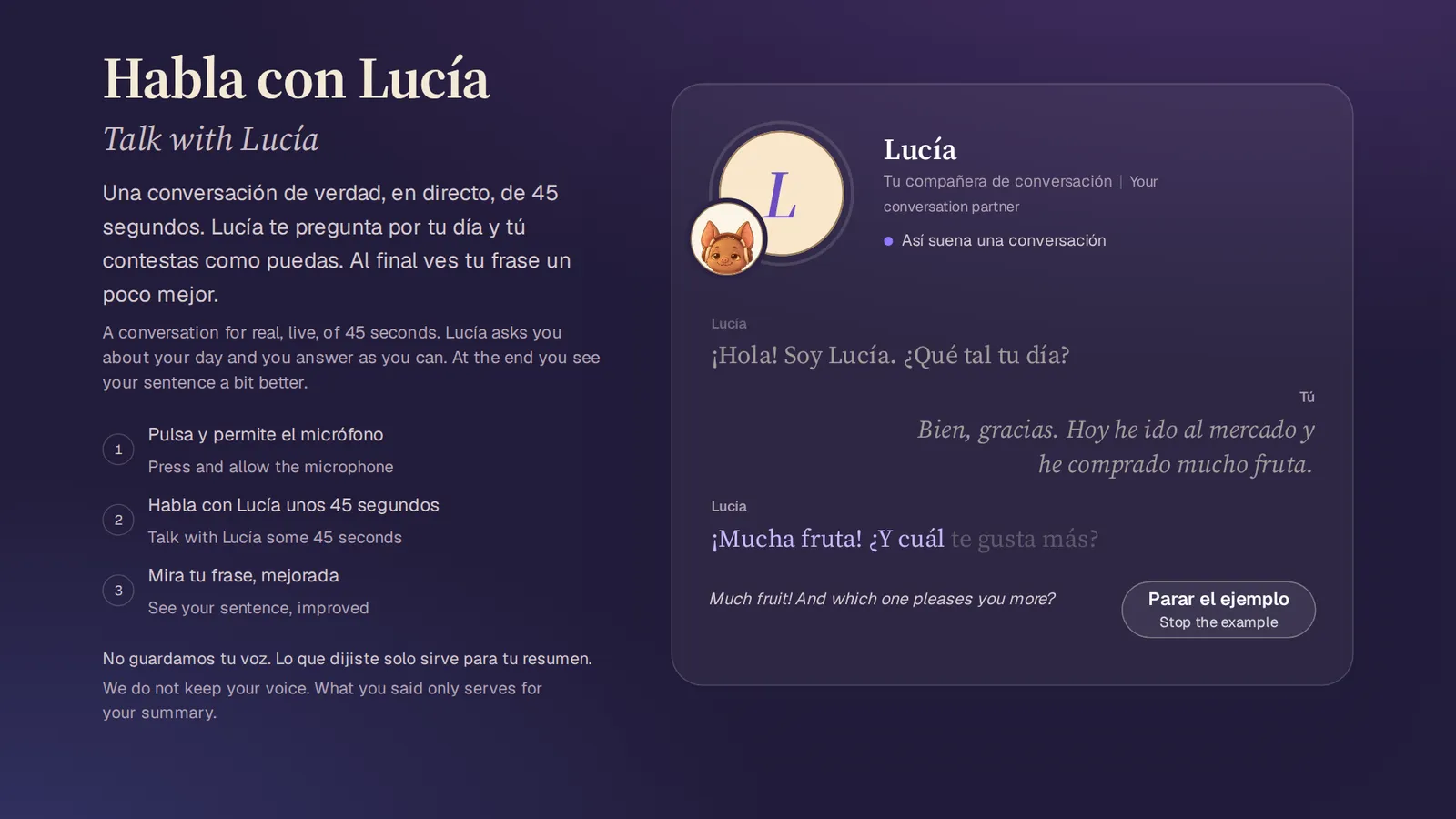
Outside the chapters there is free conversation with Lucía, who asks about the things you're interested in and, after each of your turns, gently suggests a more natural way to say it. You can also talk with her for 45 seconds right on the site's home page and see one of your sentences, slightly better, at the end.
Corrections that don't interrupt
Nobody stops you mid-sentence to explain a rule. When you make a mistake, your partner simply says your idea back correctly and keeps going. You say Ayer yo iba al cine ("Yesterday I was going to the cinema") and hear back ¿Ayer fuiste al cine? ¿Y qué viste? ("You went to the cinema yesterday? What did you see?"). This is called a recast: you hear the right form inside the conversation, without losing your thread.
Everything said appears as captions while you talk. If you need help, there is a panel of useful phrases to hand, and every correction can be tapped and heard afterwards.
The monologue: the same story three times, faster each time
The other form is a monologue on one topic, told three times in a row, each round shorter than the last. At A1 that is 40, 30 and 20 seconds; at A2, 60, 45 and 30; from B1, two minutes, a minute and a half, and one minute.
Why tell the same story three times? In the first round you are hunting for words. In the second they are within reach, so you can think about linking your sentences. In the third you have less time for the same story, and your speech speeds up on its own. A words-per-minute counter shows it in numbers. The first two rounds get short feedback; the third gets the full debrief.
Pronunciation, word by word
Pronunciation is checked only where it is known what you were meant to say: sentences you repeat after the voice (shadowing), examples from the explanation («Dilo tú»), the full sentence after an exercise («Dilo») and the back of a review card. Scenes, free conversation and monologues have no reference text, so pronunciation isn't scored there: the workbook doesn't make things up.
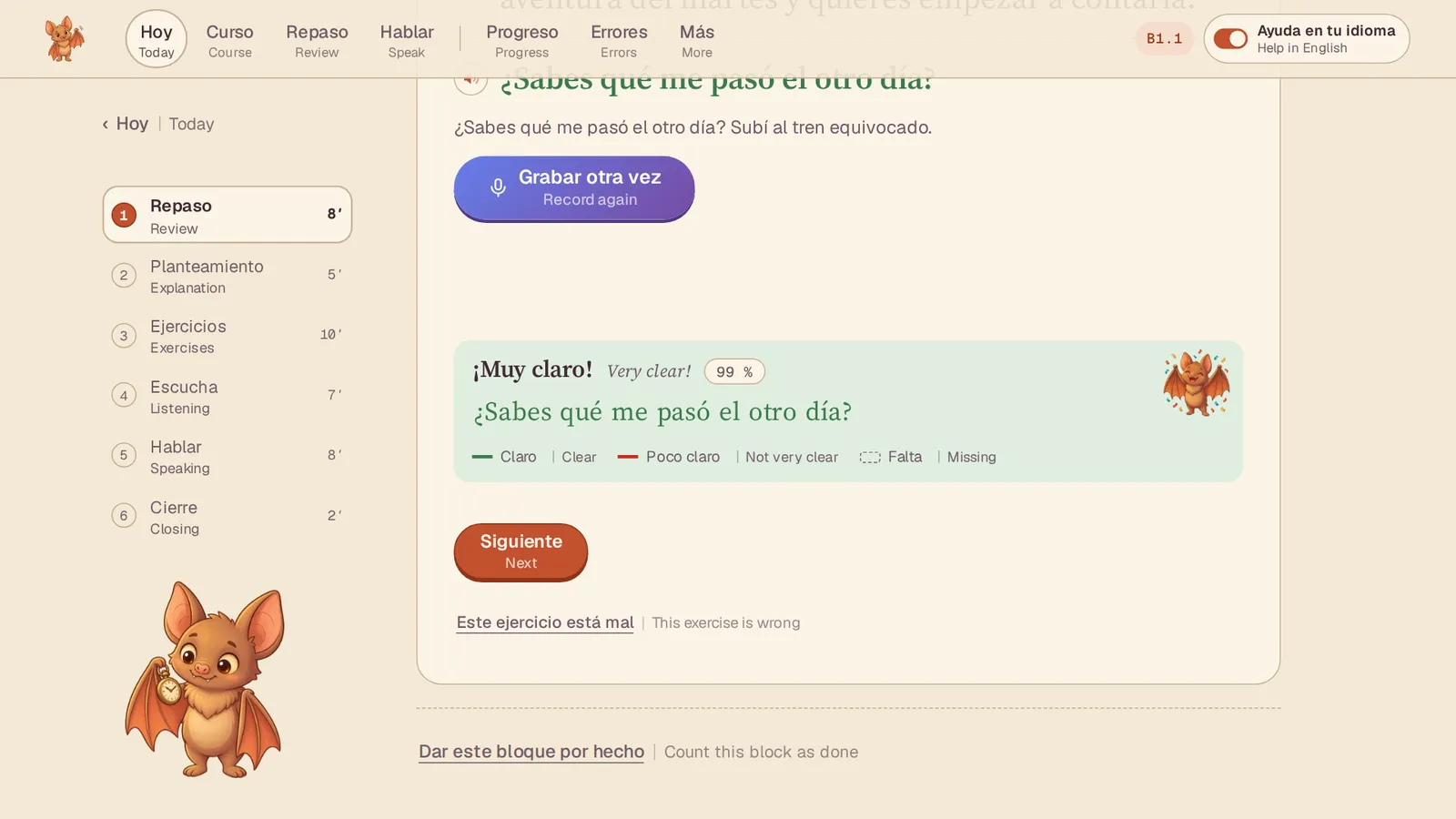
Each word gets a mark: claro (clear), poco claro (not very clear) or falta (missing). So you see the exact word that got swallowed or came out wrong, not a vague "your pronunciation is fine".
The debrief after speaking
When a scene or a monologue ends, you get a debrief that looks like a notebook marked in red pen:
- a short summary and what went well;
- your sentences with corrections: what you said, what's better, and why;
- which of the chapter's structures you used and which you avoided;
- your speed in words per minute, your filler words and your longest turn;
- phrases worth learning, and one thing to try next time.
Mistakes and new phrases turn into review cards on their own and come back just before you'd forget them; that is the subject of Mistakes that come back.
Speaking is also the heaviest part of a chapter: 35 points out of 100, and the next chapter opens at 80. To earn them you play at least two scenes and one full three-round monologue, with the third round no slower than the first. The other points, and the whole road through the chapters, are in The level test and your road; how the rest of the evening is built around this block is in One evening of Spanish.
How much you can speak
Monologues, review and corrections have no limit. Live conversation is counted in minutes: 120 a month on Basic, 360 on Intensive, and a single conversation lasts up to 20 minutes.
You'll start speaking in the level test itself — it includes a short monologue. Take the test: ten minutes, free.