
Blog · · 7 min de lectura7 min read
One evening of Spanish: six blocks, and why they come in this order
How a 20-, 40-, 60- or 90-minute session is built — review, explanation, exercises, listening, speaking, closing — and why speaking is in every plan.
Learn, Speak, Repeat!
Evening, phone, headphones. You open the «Hoy» (today) screen and instead of a list of lessons you see tonight's path: six blocks, each with its minutes. You tap «Empezar» (start) and the workbook walks you through them one by one. If you stop halfway, a reload puts you back in the same block, on the same item.
Here is what it looks like:
First, you choose your time
Twenty, forty, sixty or ninety minutes — whatever you have tonight. The workbook builds the session to fit:
| block | 20 min | 40 | 60 | 90 |
|---|---|---|---|---|
| Repaso — review | 5 | 8 | 10 | 15 |
| Planteamiento — explanation | – | 5 | 8 | 10 |
| Ejercicios — exercises | – | 10 | 15 | 20 |
| Escucha — listening | – | 7 | 10 | 15 |
| Hablar — speaking | 13 | 8 | 15 | 25 |
| Cierre — closing | 2 | 2 | 2 | 5 |
Look at the first column. On a tired 20-minute night you get review and speaking, nothing else. Speaking is in every plan: everything else exists to feed it. Forty minutes is a normal working evening — and it is work, not background noise while you cook.
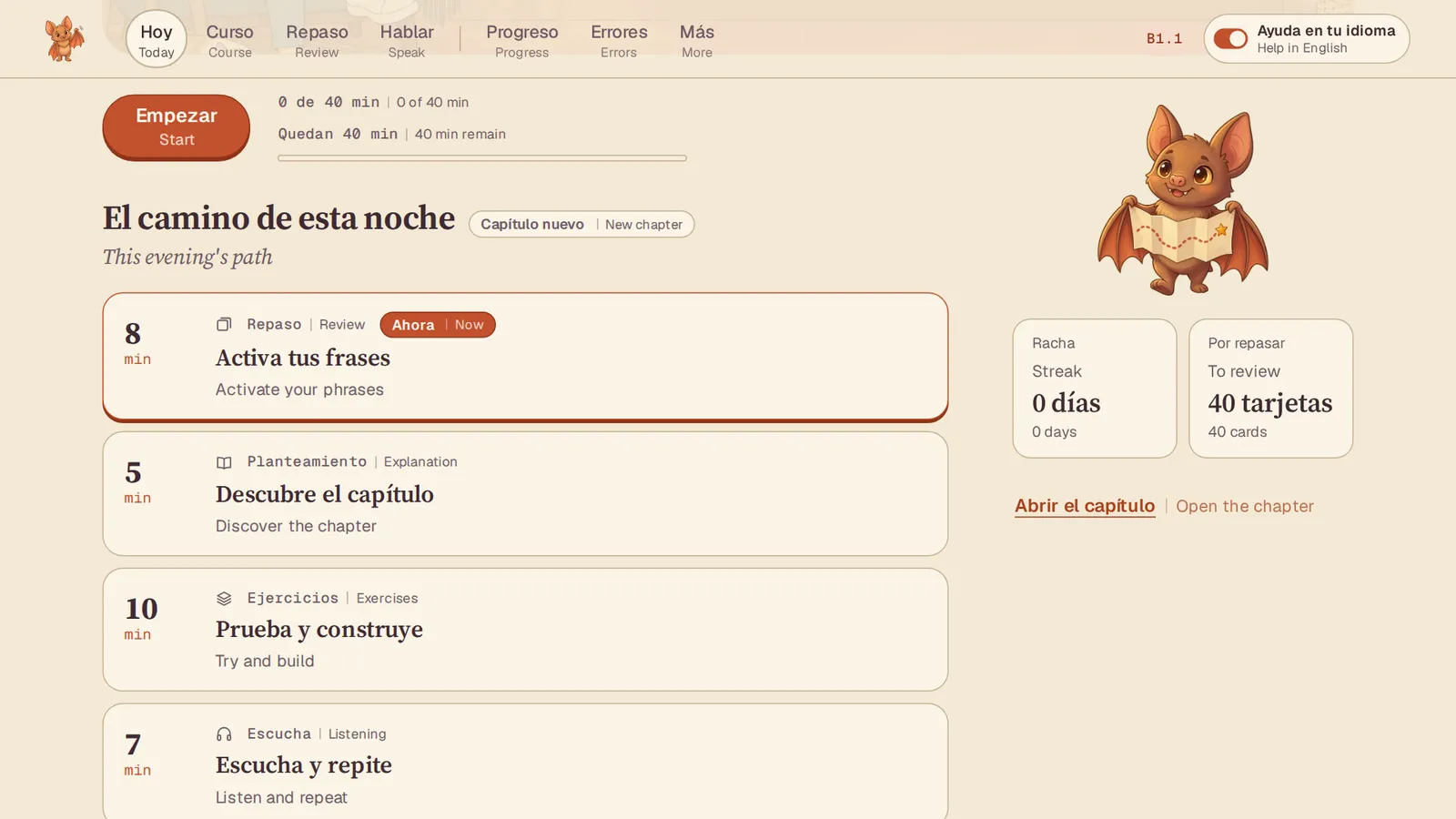
The whole screen is in Spanish. With «Ayuda en tu idioma» (help in your language) switched on, a thin English line sits under every Spanish one. Spanish stays the main text; the English is there so you can match it word for word.
Repaso: start with what you're about to forget
The evening opens with cards: phrases from your chapters and your own mistakes. Each one arrives right before you would forget it and asks you not to recognise the phrase but to produce it, aloud or typed. How that timing is worked out, and why last night's mistakes are waiting for you first, is the subject of Mistakes that come back.
Planteamiento: short, and built on examples
This block appears only on the first evening of a new chapter: a short explanation and a model dialogue in two voices, one from Spain and one from Latin America. The explanation comes as a deck of cards, one idea per card, and every card ends with «Dilo tú» (you say it): even the theory makes you speak.
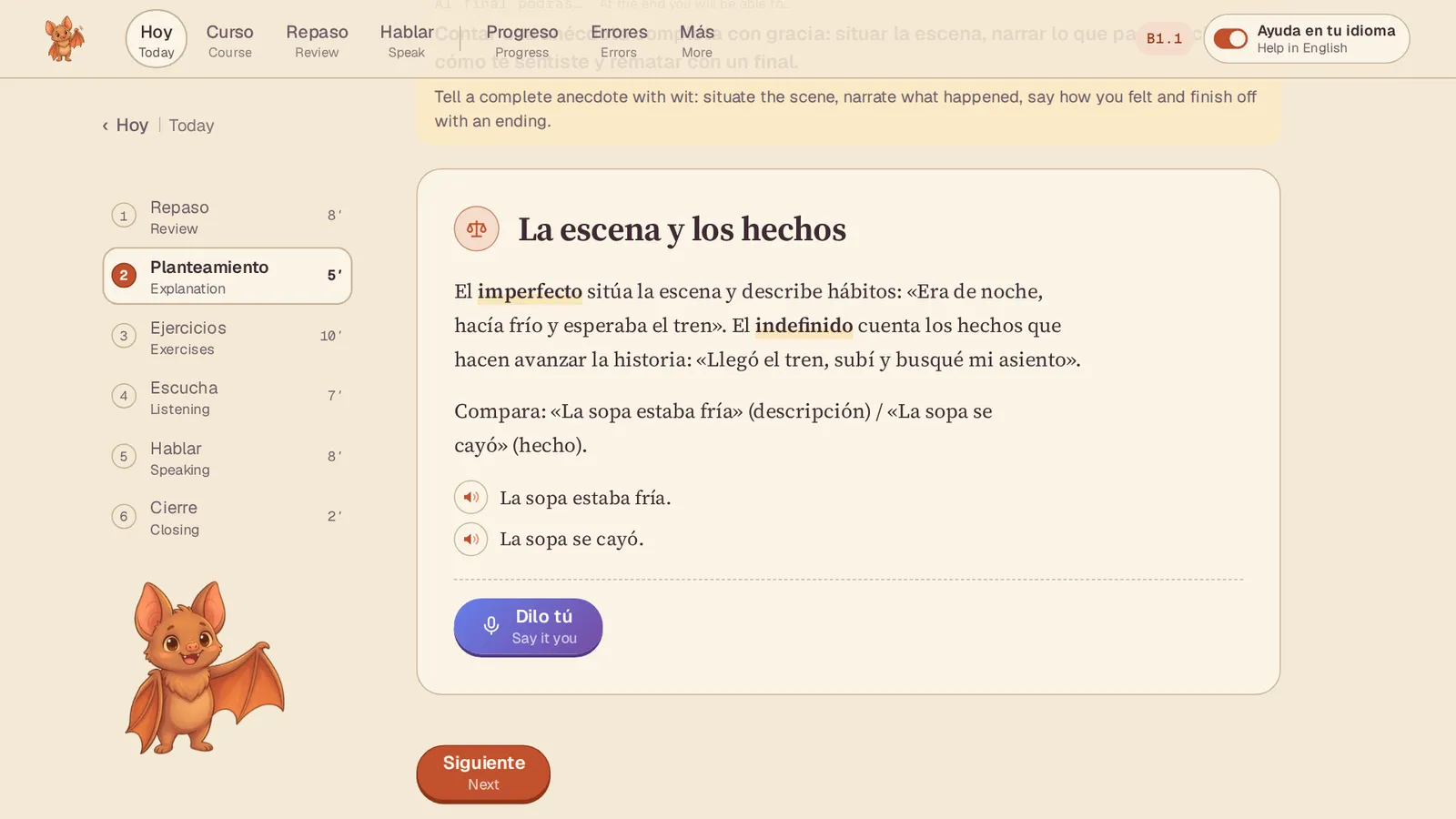
Any Spanish example — here and in every other block — can be tapped and heard.
Ejercicios: form inside meaning
Gaps, transformations, word order, free writing. The items run from easy to harder, and each one lives inside a sentence you could actually say, not in a conjugation table. Feedback is instant and explained: get it wrong and you see the whole correct sentence and one line on why.
Take Cuando era niña, Ana viajaba con sus abuelos todos los veranos — "When she was a girl, Ana used to travel with her grandparents every summer." Todos los veranos marks a habit, so it's viajaba, not viajó. English needs "used to" for that; Spanish puts it in the verb ending.
Escucha: ear and mouth
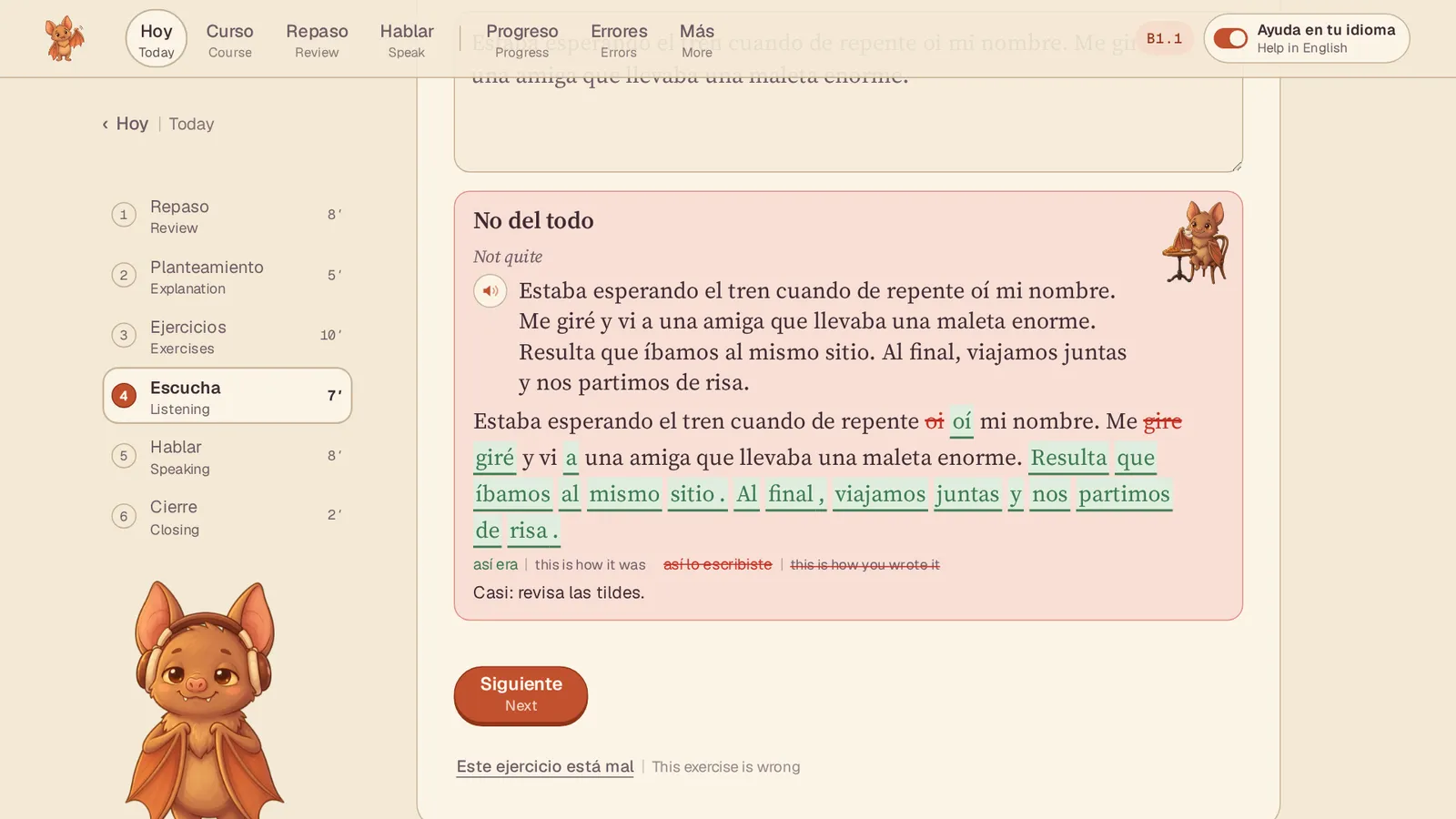
A short dictation, checked word by word: you see what you wrote against what was said, down to the accent marks. Then sentences you repeat right after the voice (shadowing), with every word marked clear, not very clear or missing. It is the bridge between "I understand it" and "I can say it": before you say a sentence on your own, you hear it and repeat it at a native speaker's pace.
Hablar: the reason the evening exists
Either a live role-play with a partner who has a name and a role, stays in it, and corrects you without interrupting. Or a timed monologue: one topic three times in a row, each round shorter, with your words per minute counted. Which one you get tonight depends on your results, and the workbook says why in one line: «Por qué hoy» (why today).
Speaking is uncomfortable at first: the pause, the blank mind, the eh… That's normal, and nobody can do this part for you. How the scenes, the monologue and the debrief work is in Speaking from the first evening.
Cierre: tonight's mistakes become tomorrow's review
The close starts with speaking: how many minutes you spoke and how your pace changed from the first attempt to the last. Then «Para no repetir» (so as not to repeat): tonight's mistakes, each with its correct form. And one question: what can you say now?
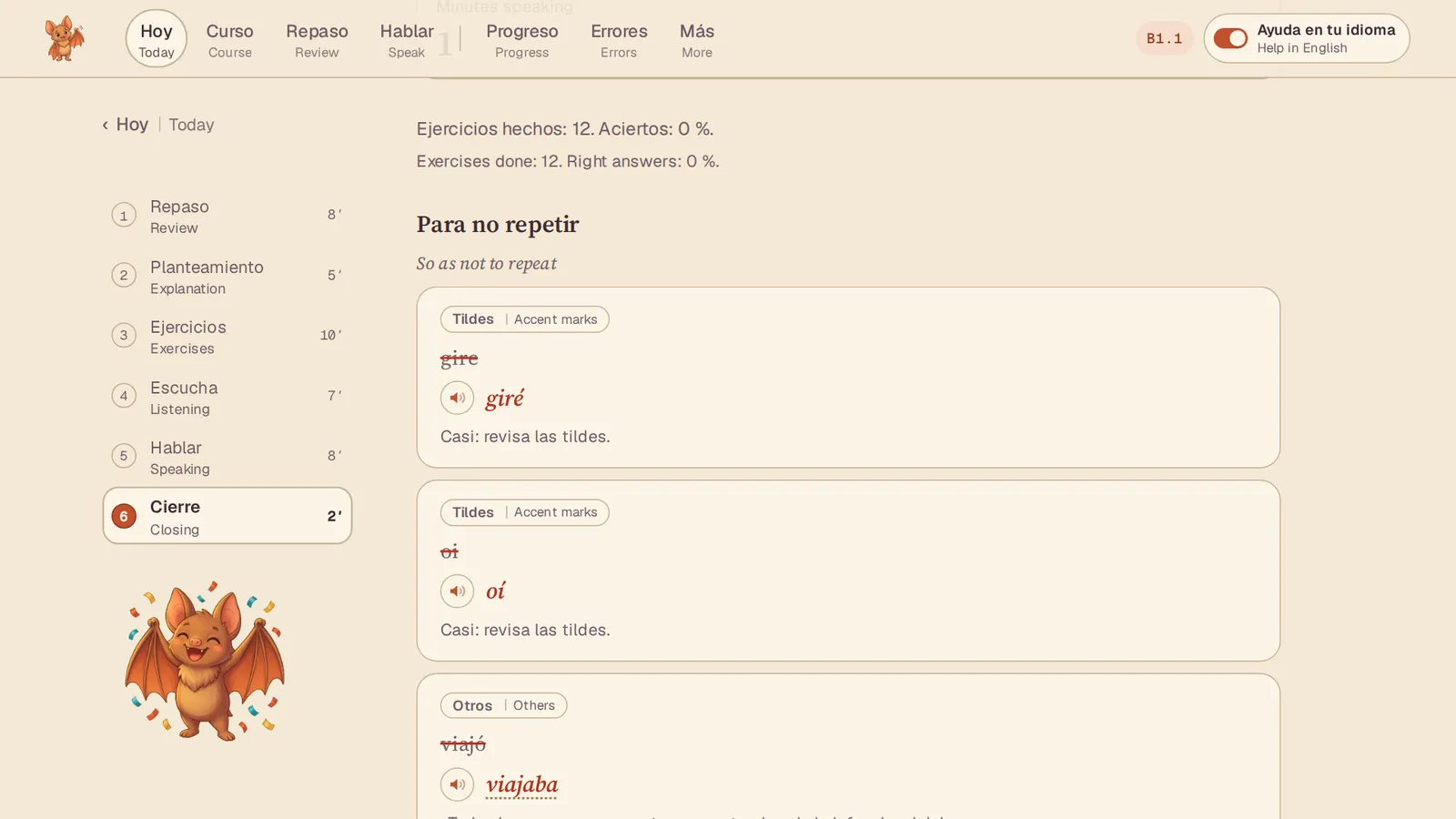
Nothing is lost: whatever you got wrong — in an exercise, the dictation, a monologue or a conversation — becomes a card and comes back in Repaso.
Why this order
Review comes first and pulls yesterday out of memory while your head is fresh. The explanation and the exercises give you the form. Listening ties the form to sound. Speaking comes last because it asks for everything at once: recall, choose the form, say it with no prompt. And the close turns tonight's mistakes into tomorrow's review, which closes the loop.
A chapter lasts three or four evenings. The explanation appears only on the first; on the evenings after, its minutes go to speaking, and some items come back from chapters you have already finished. Where you start, and what unlocks the next chapter, is in The level test and your road.
You can find where your road begins in ten minutes, with the free level test.