Cómo es una sesión y en qué se basa

How a session is and on what it is based

Cinco técnicas, cada una con su estudio; las fuentes están al final de la página.

Five techniques, each one with its study; the sources are at the end of the page.

Cómo funciona, en dos minutos y medio

How it works, in two and a half minutes

Cómo se mide tu nivel: preguntas, un audio y un rato hablando. Y después, qué capítulos te tocan y cuántas noches lleva cada uno.

How your level is measured: questions, an audio and a while speaking. And afterwards, which chapters fall to you and how many evenings each one takes.

Con subtítulos en español y en inglés, y ejemplos para quien habla inglés.With subtitles in Spanish and in English, and examples for whoever speaks English.

Seis bloques, con tiempo para hablar

Six blocks, with time to speak

Tú eliges cuánto tiempo tienes: 20, 40, 60 o 90 minutos. El cuaderno monta la sesión. Así es una noche de 40 minutos.

You choose how much time you have: 20, 40, 60 or 90 minutes. The notebook assembles the session. So is an evening of 40 minutes.

Con 20 minutos: repaso y hablar; desde la segunda sesión, también ejercicios o escucha. Si una noche no puedes hablar, el cuaderno te da práctica escrita.With 20 minutes: review and speaking; from the second session, also exercises or listening. If one evening you cannot speak, the notebook gives you written practice.

Cinco técnicas

Five techniques

Cada una con un ejemplo que puedes probar aquí.

Each one with an example that you can try here.

Técnica 1Technique 1

Recordar, no releer

Recall, not reread

Cada tarjeta te pide decir la frase, no solo reconocerla.Each card asks you to say the sentence, not only to recognise it.

Buscar la respuesta en la memoria es lo que la fija.To search for the answer in the memory is what fixes it.

Técnica 2Technique 2

Repasar con intervalos

Review with intervals

El calendario de repaso se ajusta a tus respuestas: lo que fallas vuelve antes.The review schedule adjusts itself to your answers: what you get wrong comes back sooner.

Los intervalos los calcula FSRS, el planificador de repaso espaciado de código abierto que usa Anki.The intervals, FSRS calculates them: the open-source spaced-review scheduler that Anki uses.

Próximo repaso: dentro de 1 díaNext review in 1 day

Técnica 3Technique 3

Corregir sin interrumpir

Correct without interrupting

Tu compañero de voz repite tu frase bien dicha.Your voice partner repeats your sentence well said.

Es el «recast»: oyes la forma correcta sin perder el hilo.It is the «recast»: you hear the correct form without losing the thread.

Ayer yo ir al cine.Yesterday I to go to the cinema.

Yesterday you went to the cinema? And what did you see?

Técnica 4Technique 4

Frases hechas

Ready-made phrases

874 frases hechas en los 47 capítulos, cada una con su situación.874 ready-made phrases in the 47 chapters, each one with its situation.

Una frase entera se recuerda y se dice más rápido que palabras sueltas.A whole phrase is recalled and is said faster than loose words.

To me it gives equal (= it is all the same to me).

It is that… (= the thing is…)

I carry a while waiting (= I have been waiting for a while).

Técnica 5Technique 5

Entender antes de hablar

Understand before speaking

Español que entiendes, con imágenes y voz.Spanish that you understand, with pictures and voice.

Es el «input comprensible»: un poco por encima de tu nivel, pero claro.It is the «comprehensible input»: a little above your level, but clear.

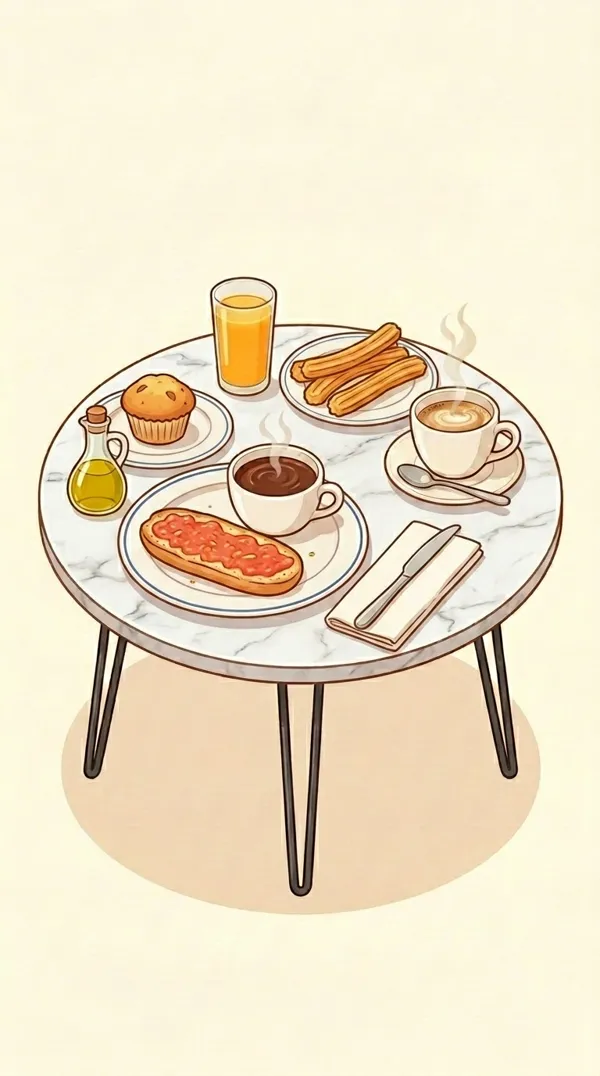
Una mesa con el desayuno

A coffee with milk

A toast with tomato

A juice of orange

Cómo se comprueba la calidad

How the quality is checked

Ninguna persona escribe ni revisa cada capítulo: lo escribe un modelo y lo comprueban otros modelos y reglas fijas. Esto es lo que se mide, con los últimos números y su fecha.

No person writes or reviews each chapter: a model writes it, and other models and fixed rules check it. This is what is measured, with the latest numbers and their date.

  1. Al escribir el capítulo

    When writing the chapter

    Se comprueba la forma, que estén todas las frases hechas y escenas del programa, el orden de fácil a difícil y que la respuesta no se filtre en el enunciado. Lo que falla se vuelve a escribir, hasta tres intentos.The shape is checked, that all the ready-made phrases and scenes of the program are there, the order from easy to hard and that the answer does not leak into the instruction. What fails is written again, up to three attempts.

  2. Al corregirte

    When correcting you

    Las respuestas exactas, las de elegir y los dictados se corrigen con reglas, sin modelo. En los demás ejercicios, una respuesta que no coincide con la clave la juzga un modelo rápido, que puede darla por buena si es correcta pero distinta; si solo fallan las tildes, vale 0,8. Tus errores van al diario y vuelven como tarjetas «Corrige: …».Exact answers, choice answers and dictations are corrected with rules, without a model. In the other exercises, an answer that does not match the key is judged by a fast model, which can accept it if it is correct but different; if only the accents fail, it is worth 0.8. Your errors go to the diary and come back as "Correct: …" cards.

  3. Al hablar

    When speaking

    La pronunciación se puntúa palabra por palabra solo cuando hay un texto de referencia. Después de hablar recibes: estructuras usadas y no usadas, tus frases repetidas bien dichas, frases para aprender y palabras por minuto.Pronunciation is scored word by word only when there is a reference text. After speaking you receive: structures used and not used, your sentences repeated well said, phrases to learn and words per minute.

  4. Antes de cambiar el modelo o sus instrucciones

    Before changing the model or its instructions

    Se generan capítulos de muestra y otro modelo resuelve cada ejercicio a ciegas, sin ver la clave. Tiene que coincidir con la clave en el 95 % o más. Un modelo juez puntúa el capítulo de 1 a 5 en seis criterios: ninguno puede bajar de 3 y la media tiene que llegar a 4.Sample chapters are generated and another model solves each exercise blind, without seeing the key. It has to agree with the key at 95 % or more. A judge model scores the chapter from 1 to 5 on six criteria: none can go below 3 and the mean has to reach 4.

  5. Cuando algo está mal

    When something is wrong

    En cada ejercicio puedes pulsar «Este ejercicio está mal». Lo que marcas, y las respuestas que el modelo rápido dio por buenas contra la clave, se vuelven casos nuevos de la siguiente comprobación.In each exercise you can press "This exercise is wrong". What you flag, and the answers the fast model accepted against the key, become new cases of the next check.

Última comprobación: 6 de octubre de 2026

Last check: 6 October 2026

Capítulos de muestra: 3; ejercicios resueltos a ciegas: 72. Es una foto de ese día, no una garantía.Sample chapters: 3; exercises solved blind: 72. It is a picture of that day, not a guarantee.

Acuerdo con la clave, sin contar los fallos del que resuelveAgreement with the key, not counting the solver’s own mistakes
100 %
Capítulos que pasaronChapters that passed
3 de 33 of 3
Criterio más flojo: pistas en tu idiomaWeakest criterion: hints in your language
3,7 de 53.7 of 5
CriterioCriterionB2.1 · ruB1.1 · enC1 · en
Español correctoCorrect Spanish444
Ajuste al nivelFit to the level444
Gramática practicadaGrammar practised444
Pistas en tu idiomaHints in your language434
Escenas para hablarScenes for speaking455
PersonalizaciónPersonalisation455
MediaMean4,0 PasóPassed4,2 PasóPassed4,3 PasóPassed

Puntuación del juez, de 1 a 5, por capítulo de muestra.Score of the judge, from 1 to 5, per sample chapter.

Lo más flojo en los 3 capítulos: pistas en tu idioma, 3,7 de 5.The weakest in all 3 chapters: hints in your language, 3.7 of 5.

Hoy el modelo que juzga es el mismo que escribe el capítulo; el que resuelve a ciegas es otro.Today the model that judges is the same one that writes the chapter; the one that solves blind is another.

Fuentes

Sources

Lo que hay detrás de cada técnica: estudios que puedes leer. Cada fuente va en su idioma original.

What there is behind each technique: studies you can read. Each source goes in its original language.

  1. Recordar fija más que releer: el «efecto test».Recalling fixes more than rereading: the "testing effect".

  2. Lo que se repasa con intervalos cada vez más largos se retiene mejor que lo que se repasa todo seguido.What is reviewed at ever longer intervals is retained better than what is reviewed all at once.

    • Cepeda, N. J., Pashler, H., Vul, E., Wixted, J. T., & Rohrer, D. (2006). Distributed practice in verbal recall tasks: A review and quantitative synthesis. Psychological Bulletin, 132(3), 354–380. doi.org/10.1037/0033-2909.132.3.354
  3. Los intervalos los calcula FSRS, un planificador de código abierto; esta es la investigación en la que se basa.FSRS, an open-source scheduler, works out the intervals; this is the research it is based on.

    • Ye, J., Su, J., & Cao, Y. (2022). A stochastic shortest path algorithm for optimizing spaced repetition scheduling. Proceedings of the 28th ACM SIGKDD Conference on Knowledge Discovery and Data Mining (KDD ’22), 4381–4390. doi.org/10.1145/3534678.3539081
    • open-spaced-repetition (2022–). FSRS: Free Spaced Repetition Scheduler. Código y wiki. github.com/open-spaced-repetition/fsrs4anki
  4. Oír tu frase bien dicha, sin que te interrumpan (el «recast»), ayuda a aprender la forma correcta.Hearing your sentence said right, without being interrupted (the "recast"), helps to learn the correct form.

    • Long, M. H. (1996). The role of the linguistic environment in second language acquisition. In W. C. Ritchie & T. K. Bhatia (Eds.), Handbook of second language acquisition (pp. 413–468). Academic Press.
    • Lyster, R., & Saito, K. (2010). Oral feedback in classroom SLA: A meta-analysis. Studies in Second Language Acquisition, 32(2), 265–302. doi.org/10.1017/S0272263109990520
  5. Quien aprende frases hechas suena más fluido al hablar.Whoever learns ready-made phrases sounds more fluent when speaking.

    • Boers, F., Eyckmans, J., Kappel, J., Stengers, H., & Demecheleer, M. (2006). Formulaic sequences and perceived oral proficiency: Putting a Lexical Approach to the test. Language Teaching Research, 10(3), 245–261. doi.org/10.1191/1362168806lr195oa
    • Wray, A. (2002). Formulaic language and the lexicon. Cambridge University Press. doi.org/10.1017/CBO9780511519772
  6. Entender español un poco por encima de tu nivel: el «input comprensible».Understanding Spanish a little above your level: "comprehensible input".

    • Krashen, S. D. (1985). The input hypothesis: Issues and implications. Longman.
  7. El monólogo 4/3/2: contar la misma historia tres veces, cada vez con menos tiempo, da fluidez.The 4/3/2 monologue: telling the same story three times, each time with less time, gives fluency.

  8. Repetir detrás de la voz (shadowing) mejora la comprensión auditiva.Repeating after the voice (shadowing) improves listening comprehension.

    • Hamada, Y. (2016). Shadowing: Who benefits and how? Uncovering a booming EFL teaching technique for listening comprehension. Language Teaching Research, 20(1), 35–52. doi.org/10.1177/1362168815597504
  9. El dictado frecuente mejora la comprensión auditiva.Frequent dictation improves listening comprehension.

  10. Al hablar o al escribir te das cuenta de lo que te falta.On speaking or on writing you notice what you lack.

    • Swain, M. (1985). Communicative competence: Some roles of comprehensible input and comprehensible output in its development. In S. Gass & C. Madden (Eds.), Input in second language acquisition (pp. 235–253). Newbury House.