
Blog · · 6 min de lectura6 min read
The level test and your road: where you start and what unlocks the next chapter
A free ten-minute test: questions, an audio, a short monologue. What it measures, where you start, the three paces and what unlocks the next chapter.
Learn, Speak, Repeat!
There are two bad ways to start a language course. One is sitting through Me llamo… again when you could already tell someone about your weekend. The other is jumping into a chapter that is too hard and sinking on the first exercise. That is why Learn, Speak, Repeat! starts with a level test. It is free, needs no account and no card, and takes about ten minutes. It isn't an exam. It's the entrance to your road.
What happens in those ten minutes
First, one question about you: ¿Cuánto español entiendes? — "How much Spanish do you understand?" Your answer decides where the questions begin.
Then come short tasks: pick an option, fill a gap, match a picture, build a sentence from word tiles. Each answer chooses the next question, anywhere from A1 to C2. You don't see a running score, only a calm section name, and there is no going back. «No lo sé» (I don't know) is always there, and pressing it is more honest than guessing: a lucky guess sends you towards chapters that will feel heavy.
Next, an audio at your level. You can play it twice, then answer a question about it.
Then «Hablar un rato» (speak a while): a topic pitched at your level and somewhere between thirty seconds and a minute and a half of talking out loud. Speaking into a microphone with no preparation is uncomfortable, and that's normal. But this is the only part that shows how you build sentences on the fly.
Finally, two sentences you read aloud. Each word is coloured by how it came out, with up to three tips on which sounds to polish. You can skip this part, and the speaking one, but then your result has nothing to say about those skills.
At the end you say what you're interested in and how many minutes you have each evening: 20, 40, 60 or 90.
What it measures
The result comes straight away. You see your level with a sub-level — B1.1, say — and a map of topics in three groups: «Ya dominas» (you already master), «Por reforzar» (to reinforce) and «Aún no» (not yet). Next to it, your skills one by one: grammar, listening, speaking, pronunciation.
Only what was actually measured counts. Grammar comes from your answers, listening from the question about the audio, speaking from what you said — how many words, over how long, how many words per minute — and pronunciation from the sentences you read. Your own view of yourself is there too, under «Tú te ves así» (you see yourself like this), but it sits apart and never turns into a score. You may feel fluent and still find that the past tenses don't come out when you talk. Knowing that is worth more than a compliment.
You can download the result as a PDF or share it as a link, with no name and none of your answers.
Where you join the road
The course is a road of 46 chapters from A1 to C2, in a deliberate order, each one resting on the ones before. The order is fixed. What is yours is where you join it.
The test names your first chapter. Everything before it is marked «Ya lo tienes» (you already have it): you don't redo those chapters, but they aren't thrown away either — their phrases enter your review a little at a time. And if you are starting from zero, your road starts at the first A1 chapter, which is just as honest a start.
Three paces: rápido, completo, a fondo
Within your level, each chapter gets its own pace, set by your topic map:
- Rápido — quick. You showed every topic in the chapter on the test. The explanation takes two minutes at most, exercises get half the time, and the minutes you save go to speaking. Speaking is never cut.
- Completo — complete. A normal chapter: explanation, exercises, listening, speaking, usually over three or four evenings.
- A fondo — in depth. The chapter has a topic you didn't know on the test. From the very first evening you get «Refuerzo de hoy» (today's reinforcement): six fresh exercises aimed at exactly that topic.
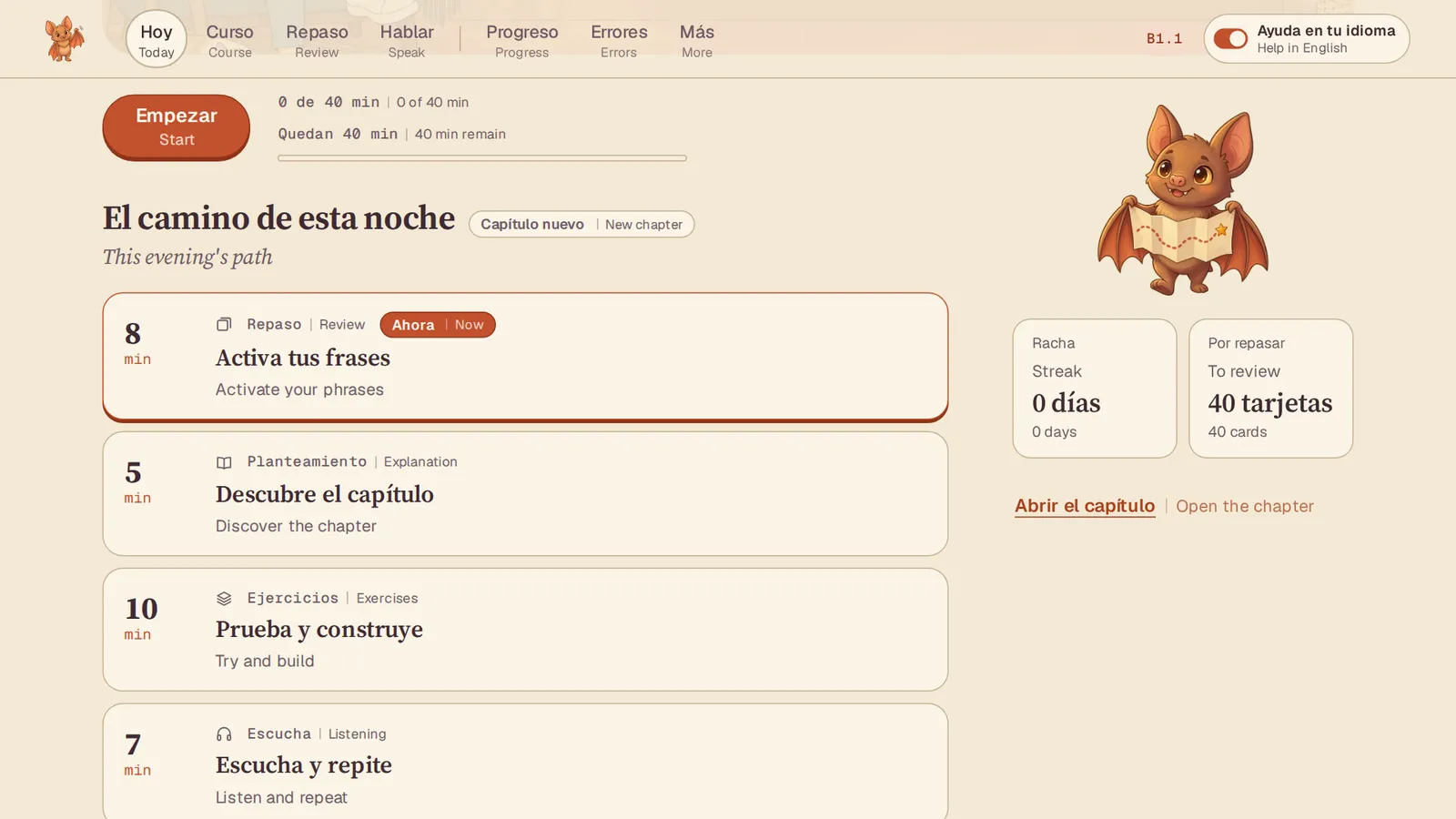
The pace is neither a reward nor a punishment. It is a way of spending your minutes where they matter most. What one of those evenings looks like is in One evening of Spanish.
What unlocks the next chapter
The next chapter doesn't open on a calendar date. It opens when you have mastered the current one. Mastery is scored out of 100, and the bar is 80:
- Speaking — 35. At least two role-plays and one full three-round monologue, and across them you use at least 60 % of what the chapter trains, correctly, at least once.
- Exercises — 30. At least 80 % right over your last twenty.
- Phrases — 20. At least 70 % of the chapter's phrases hold in your memory for three days or more — which review keeps track of, as described in Mistakes that come back.
- «Puedo…» — 15. You tick at least three quarters of the things the chapter says you can now do in real life.
Notice that even at the rápido pace, exercises and phrases count in full from the start, while speaking and «Puedo…» still have to be earned. You can't get through a chapter in silence. Why speaking starts on the first evening is the subject of Speaking from the first evening.
Mastered chapters don't disappear: their phrases keep coming back in review, some of their exercises are mixed into later evenings, and you can reopen any chapter whenever you like.
Ten minutes, and you know where your road begins: take the level test.