
Blog · · 6 min de lectura6 min read
Mistakes that come back: how review works
Every mistake becomes a card that returns right before you'd forget it. How the timing is set, how a card is graded, and why you answer out loud.
Learn, Speak, Repeat!
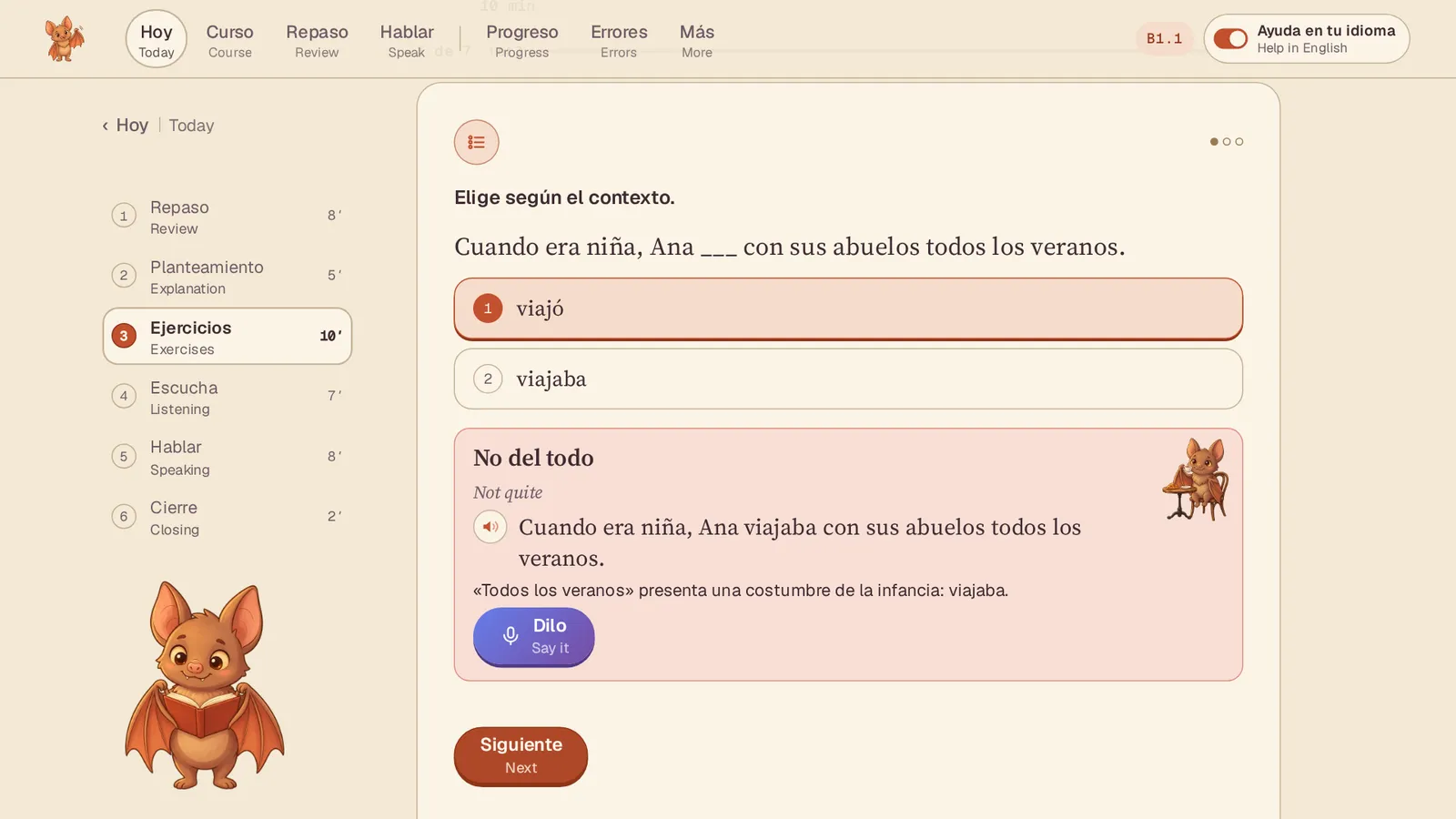
You're doing an exercise and you pick Cuando era niña, Ana viajó con sus abuelos todos los veranos. The workbook answers «No del todo» (not quite) and explains: todos los veranos is a childhood habit, so it's viajaba. You nod, tap «Siguiente» (next) and move on.
In most courses that would be the end of it. You read the correction, you understood it, and a week later you make the same mistake, because understanding and remembering are different things. Here, that mistake is only getting started.
Every mistake becomes a card
Whatever you get wrong — in an exercise, a dictation, a monologue or a live conversation — the workbook keeps and turns into a card. The front shows your own sentence, mistake included, with the task Encuentra el fallo y di la frase bien — "find the mistake and say the sentence right". The back holds the corrected version and a short explanation. Make the same mistake again and you don't get a second card; the workbook just notes that it came back.
The chapter's phrases: shown first, asked later
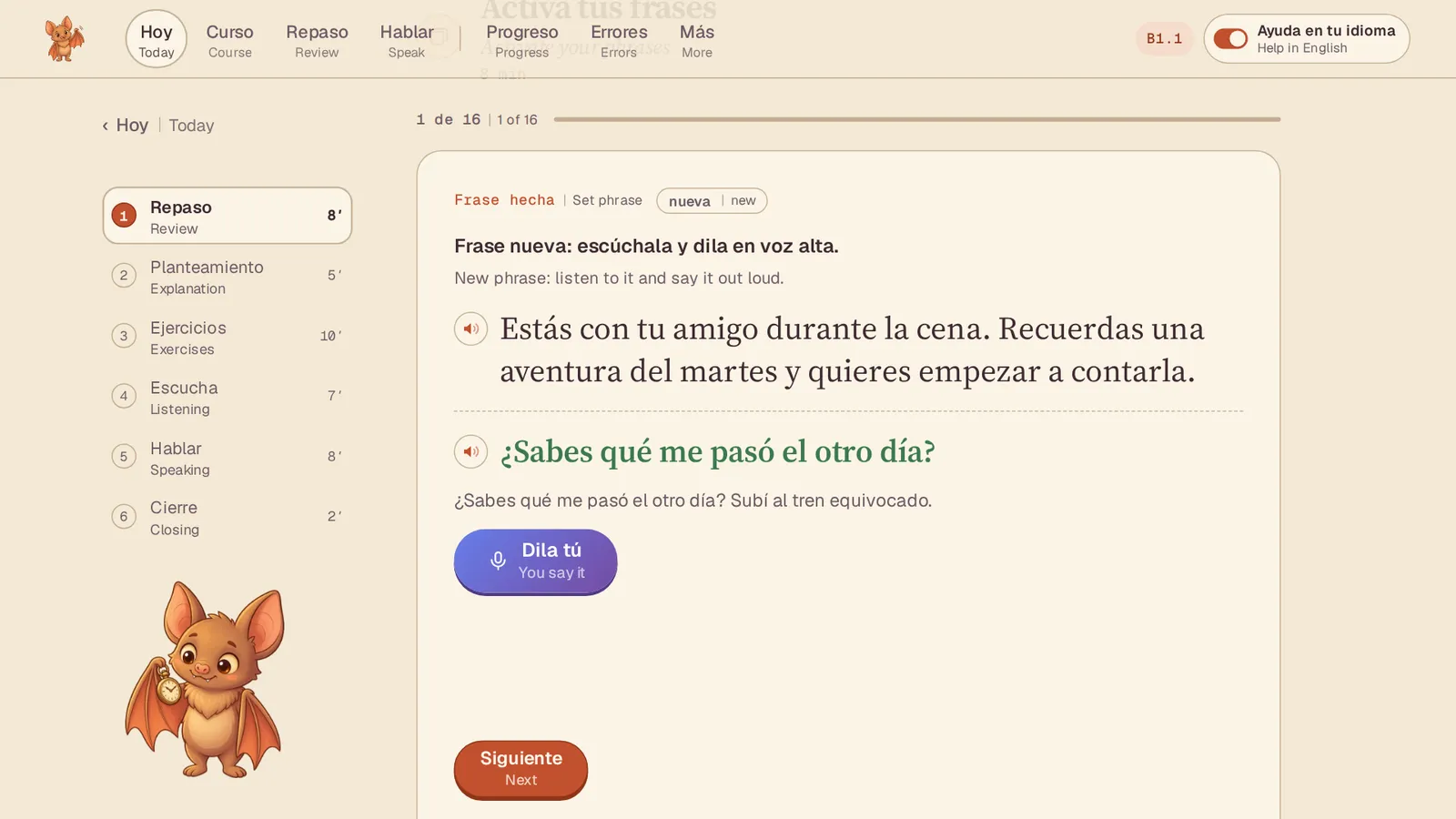
Next to your mistakes sit cards with the chapter's ready-made phrases, the things people actually say: ¿Sabes qué me pasó el otro día? — "Do you know what happened to me the other day?" A new phrase is shown before it is asked, because nobody can recall something they have never met. You listen to it, say it yourself, and next time it comes as a question: a situation in Spanish, and the phrase is yours to say.
Why tonight's mistakes are in tomorrow's Repaso
A mistake card is ready for review the moment it is made. But the evening opens with Repaso (review), and you make your mistakes later — in the exercises, the dictation, the conversation. So tonight's slips are waiting for you first thing tomorrow, as soon as you open the workbook. You see them once more at the end of the evening, under «Para no repetir» (so as not to repeat), and on consolidation evenings some exercises are written straight from your mistakes of the week, tagged «Refuerzo de hoy» (today's reinforcement) with a line saying what they train. How the six blocks make up an evening is in One evening of Spanish.
Right before you'd forget
Memory of a new phrase fades. Review it too early and you spend time on something you still know. Too late and you are learning it from scratch. The review that does the most good comes when recalling is a struggle but still works.
So every card keeps its own schedule. The workbook works out when your chance of recalling it will drop to about nine in ten and sets the review for that day. Recall it, and the next gap is longer: tomorrow, then a few days, then weeks. Miss it, and it comes back later the same day and the gaps start growing again. The intervals come from FSRS, the spaced-repetition algorithm from Anki.
Missed an evening? That's fine. The cards wait, and the next session adjusts.
Say it or type it
Every card asks you to produce the sentence, not just recognise it: searching your memory for the answer is what makes it stick. Recalling beats rereading. You can answer in two ways: say it aloud — the workbook records it, transcribes it and checks it just like a typed answer — or type it. If your mind is blank, you can reveal the answer straight away.
Speaking aloud feels awkward at first, especially when you aren't sure. But in a conversation you will have to say the sentence, so that is the skill worth training.
How a card is graded
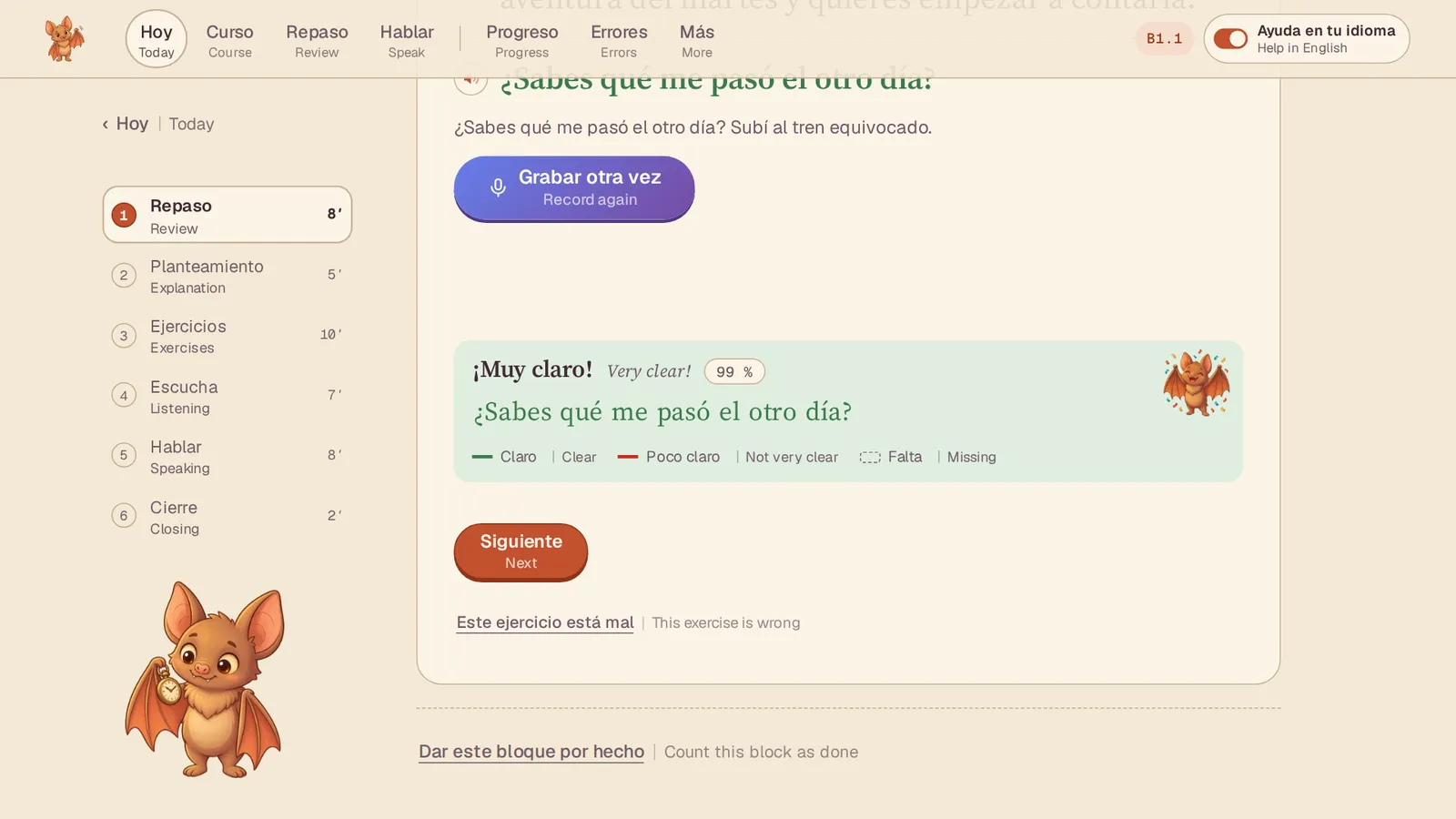
When you answer, the workbook grades it for you and tells you when the card will be back:
- it matches the answer — "good";
- everything is right except the accent marks — "hard", with the note «Casi: revisa las tildes» (almost: check the accents), and the card returns sooner;
- you said it differently — a language model checks whether your version works in that situation. A different correct phrasing counts; an answer that misses the point doesn't, and the card comes back later that day.
Disagree? Tap «Corregir la nota» (correct the mark) and set your own. If you only revealed the answer, you rate yourself: «Otra vez», «Difícil», «Bien» or «Fácil» — again, hard, good, easy. Be honest here: mark it "good" to be kind to yourself and the card will come back after you have already forgotten it. If you didn't recall it, choose «Otra vez».
How much work it is
In a 40-minute evening, review gets 8 minutes — up to 16 cards; in a 20-minute one, 5 minutes. If more cards are waiting, you can keep going. It's short but real work: you pull every sentence out of memory yourself. That is the point; easy review doesn't do much.
Review also moves you forward: how well a chapter's phrases stay with you is part of what unlocks the next chapter. More on the road through the chapters in The level test and your road, and on where speaking mistakes come from in Speaking from the first evening.
To find out which chapter your first cards will come from, take the level test: ten minutes, free.