
Blog · · 4 min de lectura4 min read
How to learn Spanish with podcasts: listen, speak, repeat
Podcasts give you real spoken Spanish, but listening alone is not enough. A practical loop — listen, read, speak, repeat — turns episodes into speaking practice.
Learn, Speak, Repeat!
Podcasts are the closest thing to living inside a language without moving abroad: real voices, real pace, real sentence rhythm. But most learners use them wrong — they press play, let Spanish wash over them for an hour, and wonder why they still freeze when it's their turn to talk.
Listening matters. It is where comprehension is built, and you cannot say what you cannot yet hear. But listening is input, and speaking is a separate skill that only grows when you produce sentences yourself — out loud, with your own mouth, at conversational speed. An episode you only listened to trains your ear; an episode you worked through trains your Spanish.
Here is the loop we build Learn, Speak, Repeat! around. It works with any audio, at any level.
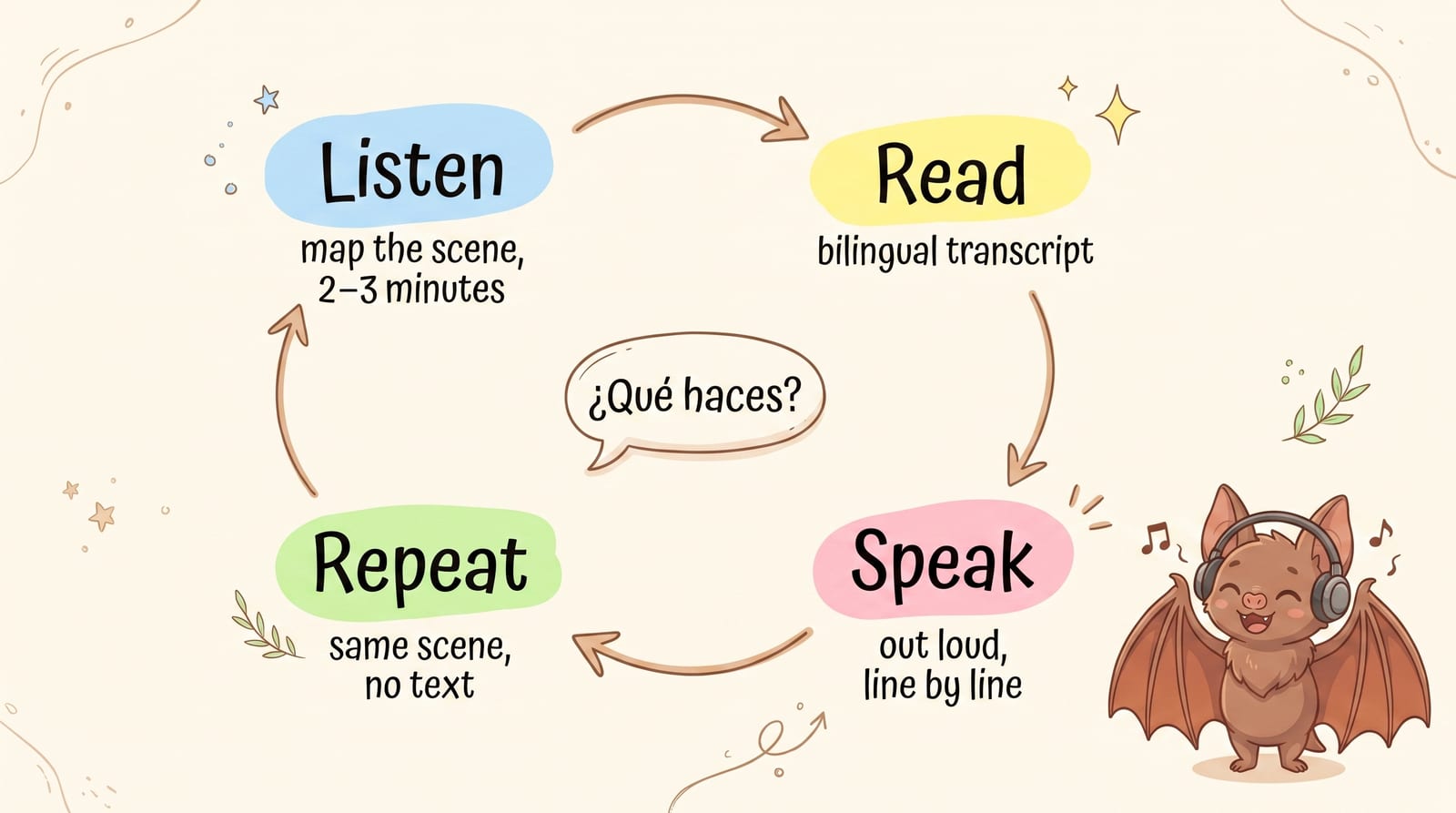
1. Listen
Play the episode (or one scene of it) without reading anything. You are not trying to catch every word — you are mapping the terrain: who is talking, what is happening, where the sentences begin and end. Two or three minutes of audio is plenty for one session.
2. Read
Now go through the same scene with the transcript — ideally bilingual, so an unknown word is one glance away instead of a dictionary detour. Notice the gap between what you heard and what was actually said: swallowed syllables, linked words, that verb form you know on paper but missed at full speed. This gap is exactly what your next listen will close.
3. Speak
This is the step most people skip, and it is the one that changes everything. Take the lines one by one and say them aloud. Imitate the speaker — the stress, the melody, the speed. If you can record yourself and compare, even better: pronunciation problems you cannot hear in your own head are obvious on a recording.
You are not memorizing lines. You are teaching your mouth the mechanics of real Spanish sentences, so that in a real conversation the shapes are already familiar.
4. Repeat
Come back to the same scene and listen again — this time without the text. What was noise a few days ago is now speech. That felt shift is the most reliable progress signal in language learning, far more honest than a streak counter.
Then move on, and let the series do the spaced repetition for you: recurring characters and settings mean the same vocabulary keeps returning in new sentences.
Choosing the right audio
- A1–A2: you need slow, scripted dialogues where you can win. Native podcasts at this stage produce frustration, not progress. This is exactly why we record bilingual episodes — everyday scenes, spoken clearly, with a translation for every line.
- B1 and up: move toward native podcasts on topics you already care about, but keep transcripts in the loop. Interest carries you through the hard parts; transcripts keep the hard parts honest.
Make it small and daily
Twenty minutes a day beats two hours on Sunday. One scene, four steps, done. The loop is small enough to survive a busy week — and consistency, not intensity, is what compounds.
If you want the whole loop in one place — episodes, bilingual transcripts, and speaking practice with feedback — that is what Learn, Speak, Repeat! courses are for.